Did you know that email marketing has the highest ROI of all digital marketing channels?
With an average ROI of 42:1 there is no reason your painting business shouldn’t be investing time into this marketing strategy.
In this article I’m going to review the benefits of email marketing in a seasonal industry, the results you should aim for, and how to setup a successful email marketing campaign for your painting business.
Let’s jump in!
Email Marketing Audience Types
There are countless reasons you MUST have a basic email marketing strategy in your painting business, but let’s review the important points.
On the Residential Painting side, there are three main audiences types:
For Commercial Painting, there is only one primary audience type:
Like a phone number, it’s a safe assumption that most everyone who will engage you for business has an email address.
The benefit of email marketing is it’s less invasive than phone calls or text messages, it’s easy to set up, and did I mention it’s extremely profitable?
Target KPIs
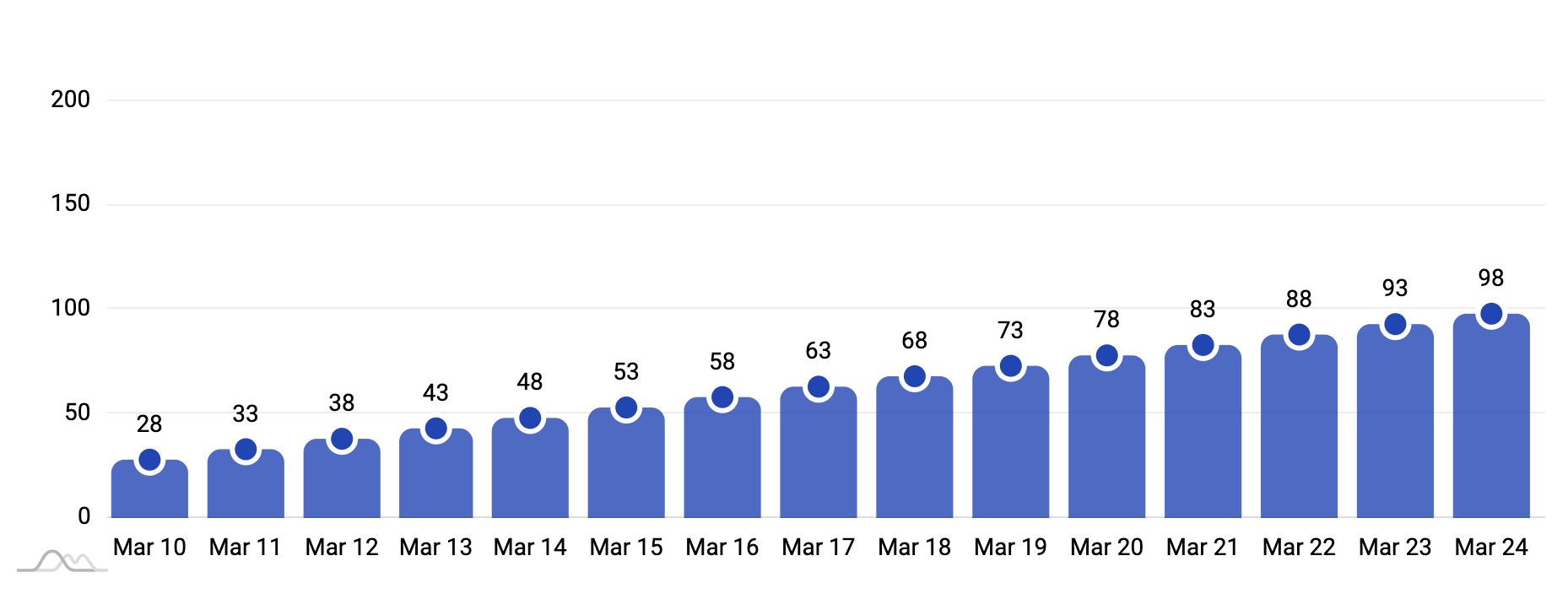
Email marketing results depend entirely on the quality and size of your email list.
For instance, if you acquire 100 emails through your website, lead forms, and other first-party marketing channels, they are more likely to convert than leads purchased through a third-party email list generation service.
Here are some target numbers to aim for:
Take this real-world residential painting email marketing scenario:
You send an email once a month to 500 contacts.
With a 1-2% average conversion rate (estimates/emails sent) you can expect roughly 5-10 new estimates/month from that list.
If we take the industry average close rate (estimates/closed jobs) of 35% you are looking at an additional 20-40 new projects from 12 emails over 12 months 🤯
Building a high-quality email list

Most painting contractors we talk to do not have a mailing list. This makes sense given that email marketing is an underutilized channel in the painting industry.
Fortunately building an email list is easy, but it can take time!
Let’s review the two primary methods of capturing new contacts.
1. First-party contacts
Any lead you capture from your marketing channels is considered a first-party contact. These are the highest-quality contacts as they have established buyer intent by providing their contact information, they are familiar with your business, and they are exclusive to you.
Here are so common ways we see painting businesses acquire first-party contacts:
2. Third-party contacts
You can purchase third-party email lists from data aggregators to quickly build up a mailing list of homeowners or business owners in your local market.
This option expedites the process, but you’re purchasing leads that others in your market have already tapped into. Also, these contacts are cold, and completely unaware of your business, so you should expect conversion rates to be lower.
There are two data aggregators we recommend for building your email list:
4 ways to avoid the dreaded SPAM filter
While email marketing is a low-effort marketing channel, the success or failure of a campaign is in the setup.
1. Validate your email lists
This is especially important if you are purchasing a third-party list as the emails they capture are not always valid. You may be provided a fake email or the address could have been mistyped.
Sending dead emails or “catch-alls” can quickly get your domain blacklisted and put you in the SPAM filter, permanently.
Your contact list must contain 99.9% valid email addresses!
Fortunately, there’s an easy and inexpensive way to mitigate this.
Most email service providers have this feature built-in. If yours does not, simply upload your email list to NeverBounce and they’ll confirm which emails are valid and which are unreachable.
2. Use an email warmup service
Email warmup is a practice of slowly sending emails to ensure they hit your recipient’s inbox and not their SPAM folder.
If you’re starting from scratch and you have a small mailing list (under 100 contacts) simply start sending to your immediately, even if it’s just to one or two recipients. This will naturally warm up your domain.
If you have a large, established mailing list you will need to use a third-party email warmup service first. We like Warmbox for its simple interface and its ability to integrate with several email service providers.
Instantly is another great all-in-one alternative.
IMPORTANT: Do NOT use your primary domain name to send marketing emails.
We recommend creating a subdomain, such as hello@mail.yourdomainname.com.
Why?
Because it is extremely easy to burnout a domain name in spam filters, and once you’re blacklisted it can be difficult to have that reinstated. Imagine not being able to communicate with customers or send out invoices!
You want to avoid that at all costs, so be sure to send from a subdomain or purchase a new domain that is completely separate from your primary.
3. Email marketing compliance
The FTC has a federal act on the books called CAN-SPAM that sets rules for the use of commercial email marketing.
In short, this act prohibits businesses from using misleading information in the subject or body of the email and requires easy opt-out/unsubscribe options for the recipient.
Be sure that your emails are relevant to your audience and contain an unsubscribe link.
4. Other SPAM filter flags to avoid
There are several other factors that contribute to inbox placement, but just a few play a significant role:
3 ways to increase open rates

Your open rate (how many people opened your email/emails sent) is a leading indicator of success.
For instance, if you sent out 500 emails but only 2 people opened them, the likelihood of generating any estimates from that campaign is extremely low. There simply isn’t enough VOLUME!
Increasing your open rates will give you more “time at bat” — This is done with personalization!
1. Segment your list
Segment your lists! See the audience types from earlier in this article.
What you send your contacts should be relevant and specific to them.
For example, you wouldn’t want to send an email trying to capture referrals or repeat business to a cold list that has never worked with you before.
Examples for residential painting contractors targeting homeowners:
Residential Bucket #1: Leads & Prospects
This one is obvious, simply create a campaign that triggers each month with a promotion or incentive. Tailor your promotions to the time of year or industry trends. You are only trying to SELL THE ESTIMATE with this outreach:
Residential Bucket #2: Past Customers
Customers you have already served will likely buy from you again, but more importantly, they can generate referrals and reviews! Examples of this outreach include:
Examples for commercial painting contractors targeting business owners:
Commercial Bucket: Leads & Prospects
With B2B marketing you are a commodity. You are simply trying to meet your prospect when they are ready to talk, or request a bid. Do this by proactively addressing the common pain points of the commercial painting industry:
2. Structure your emails for success
It’s can be tempting to use a fancy email template with nice images and buttons to represent your business. AVOID THIS MISTAKE!
The best emails have the following traits:
3. Send at the right time
There are several schools of thought about the best time of day and days of the week to send emails for optimal engagement.
For instance, you wouldn’t want to send emails on a Monday morning as this is the busiest day of the week for most.
The same applies to Friday afternoons as your audience is likely checked out for the weekend.
For best results send mid-week on Wednesday or Thursday first thing in the morning.
Swipe & Deploy Email Templates
Examples can inspire, so here are a few example email templates you can use in your painting business to target specific lists with relevant outreach.
Target: Past Customers
Use this email template to reactive past customers:
Subject Line: Ready for Spring?
Body:
Hi [First Name]!
This is [Your Name] with [Company Name] 👋
This is a simple reminder that Spring is right around the corner!
Most homeowners we serve begin pressure washing and repainting their home around this time of the year.
Right now we have an early-bird promo for 10% off all exterior painting projects booked before [Date].
Our schedule is filling up fast so we can only reserve this offer to the first 5 homeowners who respond to this email.
Do not hesitate to call/text me at [Phone Number] should you have any questions in the meantime.
PS – As a reminder, we also provide virtual estimates if scheduling is a concern!
Talk soon,
[Your Name]
[Company Name – Link to Website]
[Phone Number]
Target: Warm Prospects
Here is another example of an email targeting warm leads who submitted their information through a contact form, but never booked an estimate:
Subject Line: Re: Your Estimate Request
Body:
Hi [First Name]!
This is [Your Name] with [Company Name] 👋
Thanks for reaching out!
I just received your estimate request and would like to schedule a date & time to discuss your project.
Please take a moment to grab a spot on my calendar here: [Link to Estimate Calendar]
Do not hesitate to call/text me at [Phone Number] should you have any questions in the meantime.
PS – We also provide virtual estimates if scheduling is a concern!
Talk soon,
[Your Name]
[Company Name – Link to Website]
[Phone Number]
Target: Commercial Painting
For targeting GCs or Property Management companies, use a simple email like this:
Subject Line: Are you working with unprofessional “professional” painters?
Body:
[First Name]!
I still struggle to comprehend how unprofessional our industry is.
It doesn’t take much to do this job:
- Clear communication
- Keep your worksite clean and orderly
- Be respectful
Our Team of Professional Painters are trained on these core values.
I would be happy to prove it.
Talk soon,
[Your Name]
[Company Name – Link to Website]
[Phone Number]
Measure the results
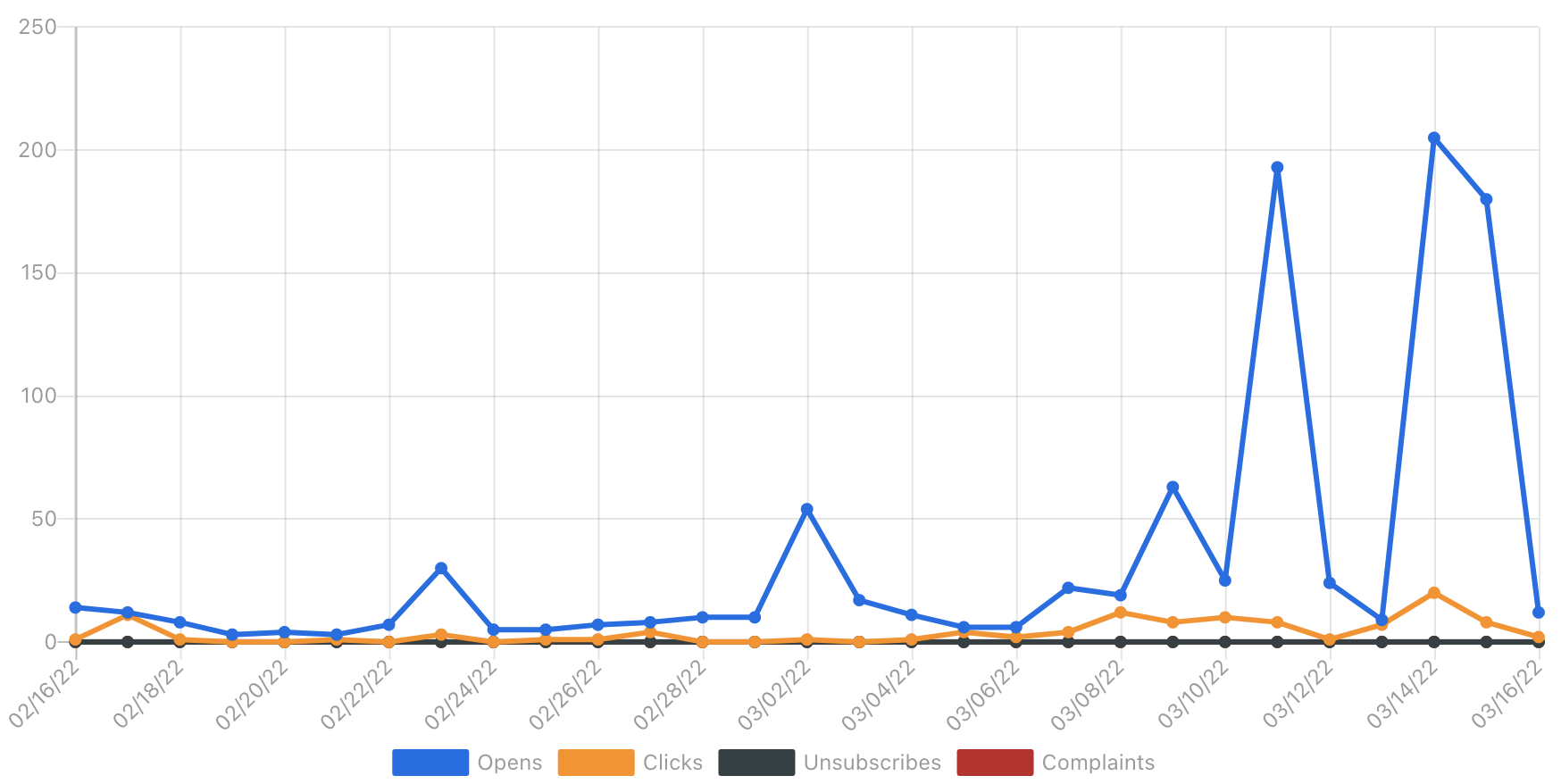
There is no point in marketing if you’re not going to measure the results. Nearly every email service provider records data and measures the results of your email campaigns. Use this!
You measure the success of your email marketing efforts using the following metrics:
Is email marketing right for you?
The short answer: If you own a residential or commercial painting business — YES
Email is a great way to reach your prospects and generate new business with little time and investment. Most painting contractors overlook this form of marketing, so use this to your advantage!